Why I Finally Made Qigong a Daily Habit – And Why You Should Too
For years, I treated wellness like a quick fix—new teas, trendy workouts, you name it. Nothing stuck. Then I found qigong, not as a cure, but as a quiet daily rhythm. It didn’t shout for attention, but slowly, I noticed more energy, less tension, and a deeper sense of balance. This isn’t magic—it’s consistency. Here’s how making qigong a regular practice changed my life in simple, real ways.
The Burnout That Led Me to Qigong
Like many women in their thirties and beyond, I wore busyness like a badge of honor. Juggling family, work, and household responsibilities, I rarely paused to check in with myself. My idea of self-care was a scented candle or an occasional spa day—pleasant, but fleeting. Over time, the constant motion took its toll. I felt drained, anxious, and emotionally frayed, even when things were going well. Sleep became elusive, and minor stressors triggered disproportionate reactions. I tried everything: detox juices, high-intensity interval training, even guided sleep meditations. Some offered brief relief, but nothing created lasting change.
Then, a close friend who had navigated a similar chapter of exhaustion suggested I try qigong. She didn’t frame it as a miracle solution—just something gentle, accessible, and grounding. I was skeptical. The word sounded exotic, almost mystical, and I associated it with practices that required spiritual beliefs I didn’t share. But her calm demeanor and steady energy were hard to ignore. Out of curiosity, I attended a beginner’s class at a local community wellness center. The room was quiet, filled with people of all ages, most dressed in comfortable clothing. There were no incense burners, no chants, just soft music and a teacher who spoke in a calm, reassuring tone.
What surprised me most was how simple it felt. The movements were slow, deliberate, and easy to follow—nothing like the complex poses of yoga or the stillness required in seated meditation. I wasn’t asked to believe anything or achieve a particular state. I was simply invited to move with my breath, to notice how my body felt, and to return my attention when it wandered. By the end of the session, I didn’t feel euphoric, but I did feel different—lighter, more centered, as if a subtle layer of tension had been lifted. It wasn’t dramatic, but it was real. That quiet shift planted a seed: maybe wellness didn’t have to be loud, complicated, or exhausting to be effective.
What Qigong Really Is (And What It’s Not)
Qigong is an ancient practice rooted in traditional Chinese medicine, built on the idea that life energy, or “qi” (pronounced “chee”), flows through the body along pathways known as meridians. When this flow is smooth and balanced, the body functions optimally. When it’s blocked or disrupted—often due to stress, poor posture, or emotional strain—discomfort and fatigue can arise. Qigong aims to cultivate and regulate this energy through coordinated movement, breath, and mindful awareness. Unlike intense physical exercise, it emphasizes softness, rhythm, and internal focus. It’s not about building muscle or burning calories, but about restoring harmony between body and mind.
One of the most important things to understand is that qigong is not mystical or religious. While it has philosophical roots, modern qigong is widely practiced as a secular wellness tool, accessible to anyone regardless of belief system. It does not require special equipment, a dedicated studio, or hours of time. It can be practiced standing, sitting, or even lying down, making it suitable for people of all fitness levels and physical conditions. This inclusivity is part of what makes it so powerful—there’s no barrier to entry, no need to be flexible or strong, just a willingness to show up and pay attention.
It’s also distinct from, yet complementary to, yoga and meditation. Yoga often emphasizes physical postures, flexibility, and strength, with varying levels of difficulty. Meditation typically focuses on stillness and mental observation, sometimes making it challenging for those who struggle with restlessness or physical discomfort. Qigong bridges the two: it involves gentle motion that supports focus, making it easier for beginners to stay present without the frustration of trying to sit completely still. It’s like meditation in motion—a way to quiet the mind while keeping the body gently engaged. Importantly, qigong is not a substitute for medical treatment. It does not claim to cure diseases or replace professional healthcare. Instead, it supports overall well-being by helping regulate the nervous system, reduce stress hormones, and improve circulation and balance.
Why Routine Beats Intensity in Wellness
In a culture that celebrates extreme fitness challenges and dramatic lifestyle overhauls, the idea of a five-minute daily practice can feel underwhelming. We’re conditioned to believe that if something isn’t difficult, it can’t be effective. But when it comes to long-term health, consistency matters far more than intensity. Neuroscience supports this: small, repeated actions rewire the brain more effectively than occasional bursts of effort. When we practice something daily, even briefly, we strengthen neural pathways associated with that behavior, making it easier to maintain over time. This is especially true for stress regulation, where the nervous system benefits from predictable, calming input.
Consider the difference between exercising for one hour once a week and moving gently for ten minutes every day. The longer session might feel more productive in the moment, but the daily practice builds resilience gradually, training the body to return to a state of calm more quickly after stress. This is where qigong shines. Its low barrier to entry makes daily practice sustainable. You don’t need to change clothes, drive to a gym, or set aside large blocks of time. A few minutes in the morning, before checking your phone, can set the tone for the entire day. Over time, this small investment compounds: better sleep, improved focus, and a greater sense of emotional stability.
Research on habit formation shows that behaviors linked to existing routines are more likely to stick. For example, pairing qigong with your morning coffee or tea creates a natural cue. The ritual of preparing your drink becomes a signal to step into your practice. This kind of integration reduces the mental effort required to start, making it easier to maintain even on busy or overwhelming days. The goal isn’t perfection—it’s presence. Showing up for yourself, even in a small way, reinforces the message that your well-being matters. And that mindset shift, more than any single session, is what leads to lasting change.
My Simple Morning Qigong Sequence (And How to Start)
My daily qigong routine takes about ten minutes and can be done in a small space—no mat required. I do it in bare feet, standing near a window where I can see the sky. The sequence is designed to wake up the body, center the mind, and prepare for the day with clarity. I’ve kept it simple so it feels manageable, even when I’m tired or pressed for time. Here’s how it unfolds:
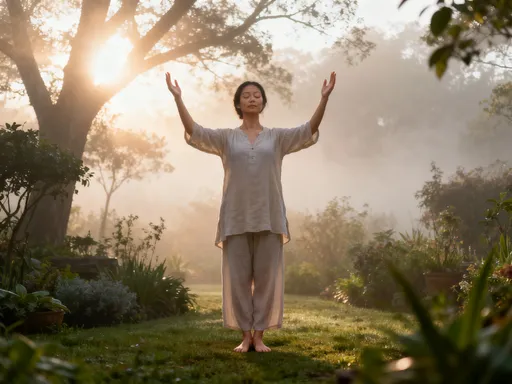
First, I begin with **Standing Like a Tree**, also known as Wuji posture. I stand with feet shoulder-width apart, knees slightly bent, arms relaxed at my sides. I close my eyes or soften my gaze and focus on my breath—inhaling slowly through the nose, exhaling through the mouth. I imagine roots growing from the soles of my feet into the earth, grounding me. This posture lasts for one to two minutes and helps me transition from sleep to wakefulness without rushing.
Next, I move into **Lifting the Sky**. I inhale as I slowly raise my arms in front of me, palms up, all the way overhead. As I lift, I imagine drawing energy up from the ground through my body and into the sky. At the top of the breath, I pause briefly, then exhale as I lower my arms back down, palms facing down, as if gently pressing energy back into the earth. I repeat this five to six times, coordinating each movement with my breath. This motion gently stretches the spine, opens the chest, and encourages deep diaphragmatic breathing.
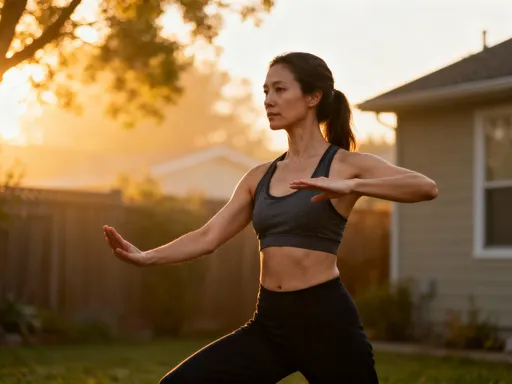
The third movement is **Separating Heaven and Earth**. I inhale as I raise one hand overhead, palm facing up, while the other hand lowers to my hip, palm down. I imagine one hand connecting to the sky, the other to the earth. After a brief pause, I exhale as I switch sides—left hand up, right hand down. I repeat this four times on each side. This movement promotes balance and symmetry in the body, and the alternating motion helps quiet mental chatter.
I finish with **Shaking the Body**, a simple but effective way to release tension. I bend my knees slightly and let my arms hang loosely. Then, I gently bounce, allowing my whole body to shake—starting from the legs and moving up through the torso, arms, and head. I do this for about 30 seconds, then stop and stand quietly, noticing how my body feels. This final step helps discharge any residual stress and leaves me feeling refreshed.
If you’re new to qigong, start with just two or three minutes of Standing Like a Tree and Lifting the Sky. You don’t need to memorize everything at once. The key is to practice regularly, even if it’s brief. Over time, you can gradually add more movements. The most important thing is to move slowly, breathe deeply, and stay present. Don’t worry about doing it “perfectly”—qigong is not about performance. It’s about showing up for yourself with kindness and attention.
What Changed After 30 Days of Daily Practice
After committing to my ten-minute morning routine for a month, the changes weren’t dramatic, but they were undeniable. The most immediate shift was in my sleep. I began falling asleep more easily and waking up feeling more rested, even on nights when I didn’t get as many hours as I’d like. My body seemed to settle more quickly at bedtime, as if the daily practice had trained it to recognize when it was time to wind down.
Mentally, I noticed a reduction in the constant background noise—the endless to-do lists, the replaying of conversations, the low-grade anxiety that used to hum beneath the surface. My thoughts didn’t disappear, but they became less urgent, less overwhelming. I found myself pausing before reacting—whether to a child’s tantrum, a delayed appointment, or a frustrating email. That small space between stimulus and response made a big difference in my emotional resilience.
Physically, my posture improved without any conscious effort. I became more aware of how I held myself while sitting, standing, and walking. My shoulders naturally dropped away from my ears, and my breathing became deeper and more rhythmic. Friends and family began to comment that I seemed calmer, more present, and less rushed. I didn’t feel like a different person—just a more grounded version of myself. There were no miraculous cures or overnight transformations, but the cumulative effect of daily practice created a foundation of stability that supported every area of my life.
How to Stay Consistent Without Burning Out
The biggest obstacle to maintaining any wellness practice isn’t motivation—it’s sustainability. We start strong, then life gets busy, and suddenly, our good intentions fall by the wayside. The secret to consistency isn’t willpower; it’s design. I’ve found that pairing qigong with an existing habit—like making my morning tea—makes it much easier to remember and prioritize. I don’t wait for the “perfect” moment; I practice right after I pour my cup, before I check my phone or open my laptop.
I also use gentle reminders: a sticky note on the kitchen counter, a notification on my phone labeled “Breathe,” or simply leaving my shoes by the window as a visual cue. These small prompts reduce the mental load of remembering, making it easier to follow through. I’ve learned to let go of the idea that a practice only “counts” if it’s ten minutes long or perfectly executed. On days when I’m overwhelmed, I do just one minute of Standing Like a Tree. That tiny act keeps the habit alive and reinforces self-compassion.
Missing a day doesn’t mean failure—it means you’re human. The key is to return without guilt or self-criticism. Each morning is a new opportunity to reconnect. Over time, the practice becomes less of a task and more of a gift—a quiet moment of care in a demanding world. By focusing on rhythm rather than rigor, I’ve built a habit that supports me, rather than one that adds pressure.
Why This Practice Fits Into Modern Life
In a world dominated by screens, notifications, and constant demands, our nervous systems are in a near-constant state of alert. We’re always “on,” always available, always reacting. Qigong offers a gentle but powerful counterbalance. It doesn’t require us to disconnect completely—just to pause, breathe, and reconnect with our bodies. In that stillness, we reclaim a sense of agency. We remind ourselves that we are more than our productivity, our roles, or our responsibilities.
What makes qigong especially relevant today is its emphasis on prevention and grounding. It’s not about fixing what’s broken; it’s about nurturing what’s already working. By regulating the nervous system daily, we build resilience against stress before it accumulates. We improve circulation, support digestion, and enhance mental clarity—all through gentle, intentional movement. It’s a form of self-care that doesn’t require spending money, joining a program, or achieving a certain look. It’s accessible, inclusive, and deeply personal.
For women navigating the complex demands of family, career, and personal well-being, qigong offers a quiet rebellion: the choice to slow down, to breathe, to be present. It’s not a dramatic overhaul, but a daily return to balance. And in that return, there’s power—not the kind that shouts, but the kind that sustains. Over time, this small practice becomes a lifeline, a way to honor your body, calm your mind, and show up for life with greater ease.
Qigong didn’t transform my life overnight, but it gave me something better: a steady anchor in the chaos. By showing up daily, even briefly, I built resilience from the inside out. This practice isn’t about perfection—it’s about presence. And in a world that never slows down, that small daily return to balance might be the most powerful health move you make.